
TL;DR
Quick summary for busy readers - key cost takeaways before you compare contractor quotes.
- Minor slipped slates or seals often run €150–€500; moderate chimney, ridge or valley work typically €500–€2,000; major structural or large flat re-covers €2,000–€6,000+.
- Most Irish leaks start at valleys, chimney flashings, gutters, ridge mortar or slipped slates - usually targeted repairs, not a full new roof.
- Dublin is about 15–20% above national averages; act within 2–4 weeks of spotting damage to avoid timber and ceiling costs.
Introduction
A roof problem never fixes itself.
What starts as two slipped slates or a crack in the ridge mortar gets worse with every rain shower, every frost and every Atlantic storm that crosses Ireland. By the time a stain appears on your ceiling, the water has often been sitting in the roof space for weeks.
Roof repair cost Ireland is one of the most searched home topics in the country. Prices vary from €150 for a minor slate fix to €5,000 or more for structural repairs caused by years of ignored leaks. The gap between those two numbers often comes down to one thing: how quickly the problem was found and fixed.
This guide gives you honest 2026 prices for every common roof repair type in Ireland. It also covers the five places where most Irish roof leaks start, the real cost of leaving repairs too long, and when repair stops making sense and replacement is the better choice.

Roof Repair Cost Ireland - Quick Price Table
Here are current 2026 prices for every common repair type. All figures include labour and materials. Scaffolding is listed separately because it varies a lot by property and repair type.
| Repair type | Cost range | Scaffold needed? |
|---|---|---|
| 1–5 slipped or broken slates | €150–€400 | Rarely |
| 6–20 slates replaced | €350–€900 | Sometimes |
| Ridge tile repoint (full length) | €600–€1,500 | Usually |
| Ridge tile replacement (section) | €400–€900 | Usually |
| Chimney flashing replacement | €400–€800 | Sometimes |
| Chimney repoint and new flashing | €700–€1,600 | Usually |
| Chimney cap (flaunching) replacement | €200–€500 | Sometimes |
| Valley repair (lead or GRP) | €500–€1,200 | Usually |
| Velux / skylight reseal | €150–€350 | Rarely |
| Velux unit replacement | €600–€1,500 | Sometimes |
| Flat roof patch (up to 5 m²) | €250–€600 | No |
| Flat roof re-cover (full, per 20–30 m²) | €1,800–€5,500 | No |
| Emergency call-out and temporary fix | €300–€800 | No |
| Gutter joint repair (per section) | €100–€250 | No |
| Full gutter replacement (semi-D) | €800–€1,800 | No |
| Fascia and soffit replacement (semi-D) | €1,500–€3,500 | Usually |
| Scaffolding for repair work | €600–€2,000 | - |
All prices are national averages for April 2026. Dublin runs 15–20% above these. Cork city is 7–10% above. Rural areas are broadly at these levels.
Use the free roof cost calculator to estimate your repair or replacement cost for your county and house type.
Where Do Most Irish Roof Leaks Come From?
Before we look at costs, it helps to know where leaks usually start.
According to data from roof repair specialists, 85% of Irish roof leaks come from five common failure points: valleys (32%), chimney flashings (28%), blocked gutters (18%), failed ridge mortar and slipped tiles making up the rest.
That means most leaks are not caused by tiles failing across the whole roof. They come from specific weak points that can be fixed without replacing the whole roof.
The five main sources:
1. Valleys - where two slopes of the roof meet. These channels carry the most water on the whole roof. When the lead or GRP valley fails, water gets in fast.
2. Chimney flashings - the metal seal between the chimney and the roof tiles. This is the single most common source of leaks on older Irish homes.
3. Blocked gutters - water backs up under the tiles at the eaves. This causes damp, rotten timber and staining inside the house.
4. Failed ridge mortar - the cement that holds the ridge tiles along the peak of the roof. It cracks over time and lets water in.
5. Slipped or cracked tiles and slates - the most visible problem. Usually caused by age, frost damage or storm winds.
Knowing this matters for one reason: most of these are targeted repairs. You do not need a new roof to fix a chimney flashing.
Slipped or Broken Slate Repair Cost
Replacing one to five slates is the most common call-out in Ireland.
Cost: €150–€400 for 1–5 slates
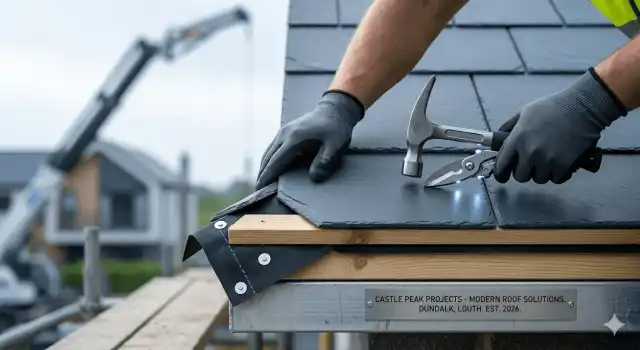
A roofer uses a roof ladder, lifts the slates around the damaged one, removes it, cuts a new slate to size and re-nails it in place. Most of this work can be done from a ladder. No scaffold needed for small numbers.
The price range reflects:
- How many slates need replacing
- Whether the roofer needs scaffold or not
- The slate type - natural slate costs more to source than concrete tile
- Location - Dublin adds 15–20%
Cost: €350–€900 for 6–20 slates
When more slates need replacing, the roofer may need scaffold access to work safely across a wider area. The cost goes up not just because of more material but because setup time is longer.
What to watch for with slate repairs
Some roofers replace the cracked slate but do not check the batten underneath. If the batten has failed, the new slate will slip again within a year or two. Ask the roofer to check the batten and fixing system before they finish the job.
Also ask about nail sickness on any property built before 1950. On older homes, the iron nails holding slates rust through over time. Slates slip because the nails have failed - not because the slates are damaged. The fix is re-nailing, which costs €2,000–€5,000 on a standard terrace. A full slate replacement costs €15,000–€22,000. The difference is significant.
Ridge Tile Repair and Repointing Cost
Ridge tiles run along the peak of the roof and are held in place with mortar. That mortar lasts 20–30 years. When it fails, ridge tiles become loose and rattle in the wind. In a storm, they blow off entirely.
This is one of the most common types of storm damage on older Irish homes.
Localised ridge repoint (2–4 metre section): €250–€600
If only one end or a short section has failed, a targeted repoint costs €250–€600. This is usually done from a scaffold platform along the ridge.
Full ridge repoint (standard semi-D): €600–€1,500
A full ridge repoint on a 3-bed semi-D means removing every ridge tile. The roofer cleans the old mortar, beds the tiles back in fresh mortar and replaces any cracked ones.
Dry-fix ridge system upgrade: €800–€2,000
Modern roofers increasingly use dry-fix ridge systems instead of mortar. Plastic clips hold the ridge tiles in place. There is no mortar to crack, no future repointing needed. If you are paying for a full repoint anyway, upgrading to dry-fix costs a bit more upfront but removes the problem permanently.
Chimney Flashing and Repointing Cost
Chimney flashings are the metal strips that seal the join between the chimney stack and the roof tiles. They are one of the most common sources of leaks in Ireland - and one of the most misdiagnosed.
Many homeowners see a water stain near the chimney breast and assume the chimney itself is the problem. Often, it is just the flashing that has failed. Fixing it is much cheaper than rebuilding a chimney stack.
Chimney flashing replacement (one chimney): €400–€800
Lead or aluminium flashing has a lifespan of 30–50 years. When it cracks, lifts or pulls away from the mortar joint, water gets into the roof space. The fix involves removing the old flashing, cutting new lead or aluminium to shape, pressing it into the mortar joints and sealing the edges.
Most single-chimney flashing jobs take four to six hours. The cost is €400–€800 including materials.
Chimney repointing: €400–€900
Mortar joints between chimney bricks wear down over time. Rain gets into the cracks. It freezes in winter and makes the cracks wider. A full chimney repoint involves raking out old mortar and replacing it with new weatherproof mortar. Most Irish semi-D chimneys take one to two days. Costs run €400–€900.
Chimney cap (flaunching) replacement: €200–€500
The flaunching is the sloped concrete collar at the top of the chimney. It holds the chimney pots in place. It cracks over time and lets water into the stack. Replacing it costs €200–€500 and is worth doing at the same time as repointing.
Full chimney treatment: €700–€1,600
Most experienced roofers quote the full chimney job - repoint, new flashing and new flaunching - as one item. Doing all three at once is always better value than separate call-outs. Each separate visit costs a call-out fee plus access setup time.
Valley Repair Cost Ireland
A valley is where two slopes of the roof meet at an angle. It channels more water than any other part of the roof. When a valley fails, leaks can be serious and fast.
Most Irish valleys use either lead sheet or a pre-formed GRP fibreglass channel.
Lead valley repair: €500–€1,200
Old lead valleys develop cracks and splits over time. Lead also gets damaged when walked on during maintenance work. A minor repair involves patching with new lead. A full replacement involves stripping both sides of tiles, fitting new lead and re-tiling. Most full valley replacements cost €500–€1,200 per valley.
GRP valley replacement: €400–€900
Modern GRP valley sections are cheaper to install than lead and less prone to cracking. Replacing a single GRP valley costs €400–€900 including labour and materials.
According to specialist roof leak diagnosis guidance, valley repairs are the most common major repair on Irish roofs, accounting for about 32% of all leak sources. Getting a valley inspected early - before a full failure - saves the cost of water damage to timber and ceilings inside.
Velux and Skylight Repair Cost
Velux reseal and flashing repair: €150–€400
The most common Velux problem in Ireland is a failed flashing kit or a worn rubber seal around the frame. This usually shows as a slow drip at the edge of the window in heavy rain. A roofer can fix most of these from a roof ladder without scaffold. Cost depends on the Velux size and how much lead flashing needs replacing.
Velux unit replacement: €600–€1,500
If the glass has cracked, the frame has warped or the opening mechanism has failed, a full unit replacement is needed. The most common type in Irish homes - the Velux Centre Pivot - costs €600–€1,200 fully installed. Larger or roof window specifications cost more.
What to check first
Many Velux leaks are not caused by the window at all. They are caused by the flashing around it failing. Before agreeing to a full unit replacement, ask the roofer to confirm whether the problem is the window itself or just the flashing. A flashing repair at €150–€400 is very different from a full replacement at €600–€1,500.
Flat Roof Repair Cost Ireland
Flat roofs on extensions, garages and older dormers are the most common source of leak calls in Ireland. They have a shorter lifespan than pitched roofs and fail more visibly.
Small flat roof patch (under 5 m²): €250–€600
A split, blister or puncture on an EPDM rubber or felt flat roof can often be repaired with a patch. On a good-quality membrane in otherwise sound condition, a proper patch lasts for years. On an old felt roof with multiple failure points, patching one area just moves the leak to the next weak spot.
EPDM rubber flat roof re-cover (20–30 m² extension): €1,800–€4,500
A full EPDM re-cover strips the old membrane and replaces it with a new one-piece rubber sheet bonded to the deck. EPDM has a realistic lifespan of 30–50 years in Irish conditions. It costs more upfront than felt but costs far less per year of use.
Fibreglass (GRP) flat roof (20–30 m² extension): €2,000–€5,500
GRP fibreglass is the premium flat roof option. It is seamless and very durable. A full GRP installation on a standard kitchen extension costs €2,000–€5,500. Many contractors offer 20-year guarantees on GRP work.
Felt (torch-on) re-cover (20–30 m²): €1,200–€3,000
Three-layer torch-on felt is the most affordable flat roof system. It costs less upfront but has the shortest lifespan at 15–25 years. For a garage or shed, it is a practical choice. For a habitable extension that you use daily, EPDM or GRP gives much better long-term value.
Gutter Repair and Replacement Cost
Gutters are the most ignored part of most Irish homes. Blocked or broken gutters cause water to back up under tiles at the eaves, rot the fascia boards and damage the timber structure inside the roof. A gutter job that costs €150 can prevent a structural repair costing €3,000.
Gutter joint seal repair: €100–€250 per section
The most common gutter failure is a cracked seal between sections of uPVC guttering. The seal wears out after 10–15 years and water drips down the fascia. This is a straightforward repair costing €100–€250 per joint.
Full gutter replacement (standard semi-D): €800–€1,800
A full replacement of uPVC guttering including downpipes on a standard semi-D costs €800–€1,800. Deep-flow gutters, which carry more water, are worth requesting for Cork and western locations with heavy rainfall.
Fascia and soffit replacement (semi-D): €1,500–€3,500
Fascia boards and soffit boards wear out over time, especially where gutters have been leaking behind them. A full replacement on a semi-D costs €1,500–€3,500. Doing it while scaffold is up for another job saves a second hire charge.
Emergency Roof Repair Cost Ireland
When a storm blows off tiles, splits a ridge or brings down a section of roof, getting the house watertight fast is the priority.
Emergency call-out and temporary fix: €300–€800
Most Irish roofing companies that offer emergency cover charge a call-out fee plus the cost of making the roof temporarily watertight. This usually means securing a heavy-duty tarpaulin or doing a quick patch on the most vulnerable area.
Emergency rates apply outside normal working hours - evenings, weekends and bank holidays. A call-out on a Sunday during a Status Orange storm warning will cost more than the same job on a Tuesday morning.
Full storm damage repair: €500–€5,000+
Free tool · about 60 seconds
Turn this guide into a number for your roof
Use the calculator to blend materials, labour, and your county uplift into one realistic range before you brief contractors.
Once conditions allow the roofer to get on the roof safely, the full repair varies by the extent of damage. Five slates blown off is a €300–€600 job. A full ridge section blown off with cracked timbers underneath is a €3,000–€5,000 job.
Insurance and storm damage
Most Irish home insurance policies cover storm damage to roofs. Flooding caused by storm damage is usually covered too. General wear and tear is not.
Take photos of the damage straight away - from the ground and inside the house if water has come in. Your insurer will want evidence. Your roofer can provide a written assessment to support the claim.
If your repair costs less than €800 and your policy excess is €300, the net saving of claiming is only €500 - which may not be worth the potential impact on your premium. For repairs over €2,000, claiming is almost always worth it.
According to Citizens Information, your insurer must assess your claim within ten working days of receiving all relevant documentation.
What Does a Roof Inspection Cost?
Before agreeing to any repair, it is worth knowing what you are dealing with. A good inspection tells you whether a targeted repair will fix the problem or whether bigger work is needed.
Basic visual inspection: €100–€200
A roofer walks around the property, looks at the roof from the ground and checks the attic from inside. They look for wet insulation, water stains on rafters and daylight showing through the roof boards. This is enough to find most obvious problems.
Full roof survey with written report: €200–€400
For older properties, before buying a house or where the leak source is not obvious, a full survey with a written report and photos is worth having. Some contractors include this in their quote process.
Drone survey: €250–€500
Drone surveys allow safe inspection of steep or hard-to-reach roofs. They are useful where the roofer cannot safely get close enough to inspect a specific area from a ladder. Most useful on large or complex roofs.
What Drives Roof Repair Costs Up or Down?
Access is the biggest variable.
A roofer who can reach a slate from a ladder charges €150–€250 for the same work that costs €600–€1,200 if scaffold is needed. The repair itself has not changed. The access cost has.
Building height.
Single-storey properties are cheaper to access than two-storey homes. Three-storey city terraces are the most expensive to scaffold in Ireland.
Roof pitch.
Steeper roofs are slower and more risky to work on. A 45-degree pitch takes longer than a standard 35-degree pitch even for the same repair type.
Location.
Dublin prices are 15–20% above the national average. Cork city is 7–10% above. Rural areas are broadly at the national average, though very remote locations can carry travel premiums.
Material type.
Natural slate repairs cost more than concrete tile repairs. The material is harder to source and takes more skill to cut and fix. Heritage or reclaimed slate on a protected structure adds more again.
What is found once work starts.
A roofer on the roof may find the damage is bigger than it looked from the ground. A repair quoted at €400 can become €800 if the batten underneath the broken slate has also failed. Always ask: "What happens if you find more damage once you start?"
The Real Cost of Waiting - Why Small Repairs Get Expensive
This is the most important section in the guide.
A small roof problem left alone does not stay small.
Water gets into places you cannot see from the ground or even from the attic. It soaks into timber. It sits behind plasterboard. It travels along rafters and appears as a ceiling stain three metres from where the water is actually getting in.
The cost difference between acting early and acting late is stark.
A roofer visits a Dublin home after a storm. Two slates have slipped. The repair costs €250. The homeowner waits until spring. By then, water has been getting in for four months. The rafter below the slipped slates has started to rot. A ceiling below has a damp patch. The repair is now €1,200 - the slates, a rafter repair and ceiling replastering.
Experienced contractors often note that a €200 repair today can prevent a €2,000+ repair six months from now. Early action is always cheaper.
The practical rule: if you spot a problem, get it looked at within two to four weeks. Do not wait until the end of the season. Do not wait until a second stain appears.
Should I Repair or Replace My Roof?
This is the question most Irish homeowners ask at some point - and the answer depends on three things: the age of the roof, the cost of the repair and how widespread the damage is.
The 25% rule
Most Irish roofers use this as a guide: if the cost of repairing your roof is more than 25% of the cost of a full replacement, and your roof is over 25–30 years old, replacement is usually better value.
A roof that is 12 years old with one localised leak is almost certainly a repair job. A roof that is 38 years old with crumbling ridge mortar, three separate leak areas and rotten timber found during a recent repair is probably ready to replace.
Repair makes sense when:
- The damage is in one area only
- The roof is under 20 years old
- The repair cost is less than 25% of replacement cost
- The roof structure underneath is sound
Replacement makes more sense when:
- Damage affects more than 30% of the roof area
- There are three or more separate leak points at the same time
- The roof has been repaired four or more times in the past five years
- Rotten timber has been found in more than one area
- The roof is over 35 years old with widespread mortar failure
See our full repair or replace guide →
Can I Claim Roof Repairs on Home Insurance?
Irish home insurance typically covers sudden damage to a roof from a storm or accident. It does not cover gradual wear and tear or damage that existed before the policy started.
Usually covered:
- Tiles or slates blown off or cracked in a named storm
- Water damage inside the home caused by storm damage to the roof
- Chimney stack damage from impact or extreme weather
Usually not covered:
- Old ridge mortar that had been cracking for years before the storm
- Slow leaks that were not reported to the insurer promptly
- Damage caused by lack of maintenance, such as blocked gutters
- General deterioration on a flat roof from old age
What to do after storm damage:
Take photos immediately. Get a written assessment from a roofer the same day or the next morning. Report the damage to your insurer straight away. Keep a record of all previous repairs - this shows you have maintained the property, which supports your claim.
Check your policy excess before deciding whether to claim. A €700 repair with a €400 excess saves you only €300 after claiming. That saving may not be worth the impact on your renewal premium.
How to Find a Good Repair Roofer in Ireland
The same checks apply for repair work as for a full replacement.
CIF membership: The Construction Industry Federation requires members to hold insurance and meet industry standards. Search at cif.ie.
CIRI registration: The Construction Industry Register Ireland is the main competency register recommended by the CCPC. Search at ciri.ie.
For repair work specifically, also look for:
Recent local reviews. A roofer with 15 or more recent Google reviews mentioning specific repair jobs in your area is far more useful than a polished website with no verifiable history.
Willingness to give a written quote. Any repair job over €300 should have a written scope - what work will be done, what materials will be used, and whether the price is fixed or estimated. A roofer who quotes verbally and adds things on completion is working outside normal standards.
Does not push unnecessary replacement. A good roofer tells you honestly when a repair is the right answer. Be cautious of any contractor who immediately pushes for full replacement on a roof under 20 years old with clearly localised damage.
Red Flags When Getting Repair Quotes
Quoting over the phone without seeing the roof.
No roofer can price a repair without looking at it. A phone quote is a guess. Always ask the roofer to visit before they quote.
No written confirmation of what will be done.
Every repair over €300 should be confirmed in writing - the scope, the materials, the price and what happens if more damage is found.
Recommending full replacement on a roof under 20 years old without opening the attic.
A ground-level look is not enough to recommend full replacement. Ask for a written explanation of exactly what structural problems justify that recommendation.
Asking for full payment before any work starts.
For repair jobs, normal payment is on completion or with a small materials deposit for larger jobs. Paying everything upfront on a repair job leaves you with no protection.
Cannot show public liability insurance.
Ask for the certificate before any work starts. Any roofer working at height on your home must carry public liability insurance. Ask to see it.
Pressure to start the same day.
"I can start right now if you pay the deposit" is a red flag on a repair job. Legitimate roofers book ahead. They give you time to check their credentials and get a second quote if needed.
Frequently Asked Questions
How much does a roof repair cost in Ireland?
Minor repairs - a few slates or a mortar patch - cost €150–€500. Moderate repairs such as chimney work, ridge repointing or a valley repair run €500–€2,000. Major repairs involving structure or a large flat roof re-cover cost €2,000–€6,000 or more.
Is it worth repairing an old roof or should I replace it?
If your roof is under 20 years old and the damage is in one area, repair is almost always the right answer. If it is over 30 years old, has widespread problems and has been repaired multiple times in recent years, replacement often works out cheaper in the long run.
Does home insurance cover roof repairs in Ireland?
Yes, for storm and sudden accidental damage. No, for wear and tear or slow leaks. Take photos straight away and report damage to your insurer promptly.
How much does an emergency roof repair cost in Ireland?
An emergency call-out to make a roof watertight typically costs €300–€800. This is more on evenings and weekends. Full storm damage repair after an assessment costs €500–€5,000 depending on how much is damaged.
Why does the same repair cost different amounts from different roofers?
Access, materials and what is included in the scope. One contractor may include scaffold. Another may not. One may use lead flashing. Another uses cheaper aluminium. Always check exactly what each quote includes before comparing.
How often should an Irish roof be inspected?
Every two years for roofs over 20 years old. Every year for roofs over 30 years old or after any major storm. A basic inspection costs €100–€200 and catches small problems before they grow into big ones.
Can I fix a slipped slate myself?
Some homeowners do this on single-storey properties from a ladder. It is risky and not recommended unless you are confident working at height. A professional roofer does this job safely and checks the surrounding slates and battens at the same time - worth the €150–€250 for most people.
Conclusion
Roof repair in Ireland does not have to be stressful if you catch problems early and know what fair prices look like.
The most important takeaway from this guide: most Irish roof leaks come from five specific places - valleys, chimney flashings, gutters, ridge mortar and slipped slates. None of these require a new roof to fix. They require a targeted repair done by a roofer who knows what they are looking for.
The most expensive mistake you can make is waiting. A €200 repair left for six months can become a €2,000 repair. A €1,000 repair left for two years can involve structural timber work and ceiling replastering.
Get an inspection, get a written quote, check the contractor is registered and act quickly. That is the whole strategy.
Use the free roof cost calculator if you are unsure whether you need a repair or a full replacement. The estimate helps you understand the cost of each option before you call a roofer.
Further reading: New roof cost Ireland 2026 · Repair or replace guide · Hidden costs of roof replacement · SEAI roof insulation grant 2026 · How to get roofing quotes Ireland · Roof cost Dublin
Official resources: Citizens Information · CIF · CIRI · SEAI grants · CCPC
Prices reflect April 2026 national average contractor rates. Dublin adds 15–20%. Always get three written quotes before committing to any repair work.
Ready to compare quotes?
Get a location-adjusted roof cost range
No signup - see how slate, tile, or flat-roof options change your budget, then share the range with roofers.